
How to Reduce E-commerce Shipping Costs Using Logistics APIs
A shipping API helps reduce e-commerce shipping costs by automating shipping workflows, comparing real-time carrier rates, optimizing package selection, minimizing shipping errors, and improving fulfillment efficiency. For growing e-commerce brands shipping domestically and internationally, a multi-carrier shipping API can significantly lower transportation expenses while improving delivery speed and customer satisfaction.
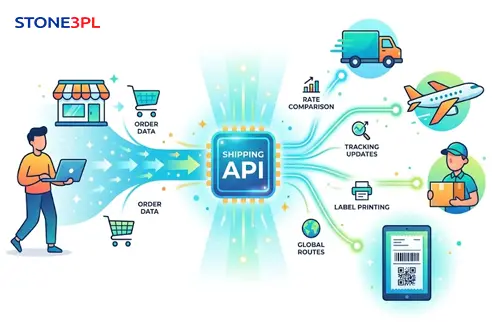
When combined with a professional third-party fulfillment provider such as Stone3PL, a shipping automation API can also streamline inventory management, order routing, international fulfillment, customs documentation, and last-mile delivery optimization, creating additional cost savings across the entire supply chain.
Why Shipping APIs Are Essential for Modern Brands
Shipping costs are typically 10–25% of total operating expenses, and they rise sharply when you sell cross-border. Manual processes, static rate cards, and single-carrier contracts make you overpay by 15–30% on average.
A multi-carrier shipping API connects your store, ERP, or warehouse system directly to 50+ global and regional carriers—express, air, sea, rail, and postal services. It gives you real-time data, full automation, and the flexibility to choose the best option for every single order.
Manual vs. API-Driven Shipping: Cost & Efficiency Comparison
| Aspect | Manual Process | Shipping API | Savings |
|---|---|---|---|
| Rate Selection | Fixed contract or guesswork | Live comparison across all carriers | 10–35% |
| Label Creation | 2–5 mins/order; high error rate | Auto-generated, compliant, batch-ready | 70–90% labor reduction |
| Customs Documents | Prepared manually; frequent delays | Auto-filled and filed electronically | 80% time savings and fewer customs holds |
| DIM Weight Management | Often miscalculated | Accurate calculation with packaging recommendations | 5–15% avoided fees |
| Invoice Auditing | Hours spent reconciling weekly | Automatically matches quoted vs. billed costs | 3–8% cost recovery |
| International Compliance | Difficult to track changing regulations | Built-in compliance support for 220+ countries | Avoids fines, delays, and shipment seizures |
How Shipping APIs Reduce Costs: 7 Proven Strategies
1. Automate Everything with Shipping Automation API
High-volume shipping magnifies every mistake: wrong addresses, invalid customs data, mismatched service levels, or duplicate labels cost thousands per month. A shipping automation API removes human intervention entirely for routine tasks:
✅ Address validation (domestic + international) → cuts failed delivery & correction fees
✅ Batch label generation → process 1,000+ orders in minutes
✅ Auto-create commercial invoices, packing lists, customs declarations
✅ Real-time tracking + proactive customer notifications
✅ Automated return labels
✅ Rules-based routing: e.g. “Orders <2kg to EU → use postal; >2kg → express”
For cross-border: it automatically applies HS codes, determines duties, and ensures compliance with import/export laws—the #1 way to avoid clearance delays and fines.
Stone3pl Advantage: Modular API endpoints; enable only what you need. Scale from 10 to 100,000+ orders/month without performance loss.
2. Live Rate Shopping with Multi‑Carrier Shipping API
Carrier prices change daily—fuel surcharges, peak season hikes, or route adjustments happen without notice. Sticking to one carrier guarantees you overpay.
A multi-carrier shipping API fetches live, accurate quotes from all available services—express, standard, economy, sea freight, special lines, and postal—at the moment of order. You (or your system) select by:
- Lowest cost
- Fastest delivery
- Best balance
- Includes duties/taxes (DDP)
✅ Works for every country: automatically shows only services that deliver there
✅ Compares your own negotiated rates and Stone3pl’s pre‑negotiated discounts (up to 60% off retail)
3. Bring Your Own Account (BYOA) + Unified Management
If you already have contracts with FedEx, DHL, UPS, or freight forwarders—don’t lose them. Stone3pl’s API lets you:
- Upload your own contracted rates
- Use them side‑by‑side with our discounted rates
- All labels, tracking, and invoices in one dashboard
- No need to maintain separate portals or rate sheets
Result: you keep your best pricing, but get the automation and control of a single system.
4. Eliminate DIM Weight & Packaging Fees
Dimensional (DIM) weight charges are the silent profit killer—especially internationally, where space costs are high. Even light items in big boxes cost as much as heavy goods.
A smart shipping API:
- Calculates exact chargeable weight: compares actual vs. volumetric (L×W×H ÷ divisor)
- Suggests smallest suitable packaging based on product dimensions
- Warns if package size increases cost
- For international: optimizes for airline/sea freight density rules
Best practices built in:
- Standardize packaging sizes
- Use mailers for soft/flat goods
- Avoid empty space → save 5–18% instantly
5. Auto‑Audit & Recover Overcharges
In high-volume shipping, 3–8% of carrier invoices contain errors: wrong weight, zone misclassification, extra surcharges, or incorrect discounts. Most brands never catch it.
Stone3pl’s API automatically:
- Compares quoted cost vs. final invoice
- Flags discrepancies with clear reasons
- Generates dispute documents
- Recovers money you are owed
→ For 10,000 orders/year, this alone pays for your integration many times over.
6. Optimize International Shipping & Customs
This is where APIs deliver the biggest extra value vs. manual tools. International shipping has unique costs: duties, taxes, clearance fees, remote surcharges, and regulatory compliance.
✅ Built‑in landed cost calculator: shows total cost to door (shipping + duty + tax) before you ship
✅ DDP/DDU selection: choose who pays—you or customer
✅ Regulatory intelligence: knows what is allowed in 220+ countries; prevents seizure
✅ Document automation: generates all required papers; sends electronically to customs → faster release, fewer delays
7. Use Analytics to Refine Your Strategy
Your API collects all data: spend, delivery time, surcharges, failure rates, carrier performance, by country, weight, and service.
Carrier-Direct APIs vs. Unified 3PL Shipping APIs
When integrating logistics technology, enterprise brands must choose between building direct integrations to individual carriers or utilizing a unified 3PL fulfillment API.
| Operational Feature | Carrier-Direct APIs (e.g., DHL, FedEx, UPS) | Unified 3PL Multi-Carrier API (e.g., Stone3PL) |
|---|---|---|
| Development Overhead | High. Requires separate codebases and ongoing maintenance for each carrier integration. | Low. A single API integration provides access to a multi-carrier global shipping network. |
| Rate Comparison | None. Only displays rates from the selected carrier. | Automated. Instantly compares rates across global, national, and regional carriers. |
| International Customs Integration | Basic electronic trade document transmission. | Advanced. Supports automated HS code matching, commercial invoice generation, and landed-cost calculations. |
| Physical Infrastructure Link | Digital only. Warehouse operations and carrier pickups must be managed separately. | Fully integrated. The API coordinates fulfillment, kitting, packing, and shipping through global warehouse networks. |
| Upfront Cost & Maintenance | Can exceed $300,000 per year per carrier in development and maintenance costs. | Flexible, usage-based API access bundled with fulfillment and logistics services. |
Why Choose Stone3pl for Shipping
Stone3pl helps e-commerce brands reduce shipping costs through third-party fulfillment services that combine operational execution with smarter shipping tools. Rather than relying only on manual rate checks or isolated carrier accounts, Stone3pl supports more scalable shipping decisions for businesses that need to move quickly and protect margins.
For brands handling high-volume shipping, this kind of support can improve consistency, reduce labor overhead, and strengthen international order fulfillment performance. It is especially useful when your business needs a more flexible shipping model across multiple destinations.
Frequently Asked Questions
Can a shipping API really lower e-commerce shipping costs?
Yes. It can reduce costs by automating workflows, comparing live carrier rates, minimizing label errors, and improving packaging and routing decisions.
Is a multi-carrier shipping API better than using one carrier?
For most scaling e-commerce brands shipping across multiple zones or countries, yes. A multi-carrier setup gives you more flexibility and better rate selection.
How does shipping automation help third-party fulfillment operations?
It reduces manual work, lowers the chance of shipping mistakes, speeds up label creation, and improves shipment visibility for both the warehouse and the customer.
What is the biggest hidden cost in high-volume shipping?
Dimensional weight charges, billing discrepancies, and service-level mistakes are often among the biggest hidden costs.
Why should B2B brands consider Stone3pl?
Because Stone3pl combines third-party fulfillment services with shipping efficiency support, helping brands reduce operating costs and scale shipping more effectively.
Reducing e-commerce shipping costs isn’t just about finding cheaper carriers — it’s about automation, data, and integration.
By leveraging Stone3PL’s shipping automation API, e-commerce brands can streamline operations, eliminate hidden fees, and scale globally with confidence.
For B2B sellers and high-volume e-commerce brands, partnering with Stone3PL’s third-party fulfillment services ensures every shipment is optimized for cost, speed, and reliability.
Reference Sources
ITA E-commerce Logistics Framework: International Trade Administration eCommerce BSP Logistics Portal
Cross-Border Business Support: ITA eCommerce Resource Center


