
What is the Difference Between CFR and DDP in Incoterms?
The primary difference between CFR (Cost and Freight) and DDP (Delivered Duty Paid) lies in the extent of the seller's responsibility and the point of risk transfer. Under CFR, the seller pays for ocean freight to the destination port, but the buyer assumes all risk once the goods are loaded on the ship and is responsible for import clearance and final delivery. Conversely, DDP requires the seller to handle the entire logistics chain, including all costs, risks, import duties, and taxes, delivering the goods directly to the buyer's door.
Table of Contents
For importers and exporters, choosing between CFR and DDP directly affects shipping costs, customs compliance, delivery speed, risk exposure, and overall supply chain efficiency. Professional freight forwarding providers like Stone3pl help businesses select the most cost-effective Incoterms strategy while reducing international shipping risks.
| Aspect | CFR | DDP |
|---|---|---|
| Risk Transfer | Buyer assumes risk once goods are loaded at origin port | Seller bears risk until delivery at buyer’s location |
| Cost Coverage | Seller pays ocean freight; buyer pays duties, inland transport, insurance | Seller pays all costs including duties, taxes, and inland transport |
| Mode of Transport | Sea and inland waterways only | Any mode (sea, air, land) |
| Buyer’s Burden | Import clearance, duties, inland delivery | Minimal – mainly unloading |
| Seller’s Burden | Export clearance, freight to destination port | Full responsibility until delivery |
Understanding CFR (Cost and Freight)
CFR is an Incoterm strictly reserved for sea and inland waterway transport. It is often preferred by buyers who have established relationships with local logistics providers in their own country and want to manage their own import process to save on "markup" costs from the seller.
Risk transfers from the seller to the buyer once the cargo is loaded onto the vessel at the origin port. This means the seller pays the freight costs, but the buyer bears the transportation risk during the ocean voyage.
Key Features of CFR:
Seller’s Obligation: The seller must arrange and pay for the Cost and Freight necessary to bring the goods to the named port of discharge. This includes export customs clearance and terminal handling charges at the origin.
Risk Transfer: A common misconception is that the seller bears the risk until the destination. In reality, under CFR, the risk transfers from the seller to the buyer the moment the goods are loaded on board the vessel at the port of shipment.
Insurance: The seller has no obligation to provide insurance. Because the buyer assumes risk during the ocean voyage, it is highly recommended that the buyer secures cargo insurance independently.
Seller Responsibilities Under CFR
Under Cost and Freight (CFR) terms, the seller is responsible for:
Export packaging and labeling
Export customs clearance
Delivery to the origin port
Loading cargo onto the vessel
Paying ocean freight charges to the destination port
Providing shipping documents such as the Bill of Lading
The seller’s responsibility ends once the cargo is loaded onboard, even though they continue paying freight costs.
Buyer Responsibilities Under CFR
The buyer is responsible for:
Cargo insurance (optional but strongly recommended)
Import customs clearance
Import duties and taxes
Destination port charges
Inland transportation to final delivery address
Managing risks after cargo loading
Because risk transfers early in the shipping process, buyers using CFR often work closely with international freight forwarding companies to manage import logistics efficiently.
When Should You Choose CFR?
CFR is usually the better option when:
The buyer has strong import experience
The buyer wants control over destination logistics
The importer has local customs brokers and trucking partners
Ocean freight costs are competitive
Bulk cargo or non-containerized shipments are involved
Many manufacturers and wholesalers use CFR when importing large volumes regularly.
Understanding DDP (Delivered Duty Paid)
DDP represents the maximum obligation for the seller. It is a "door-to-door" service that is increasingly popular in the e-commerce fulfillment and 3PL sectors because it offers a seamless experience for the buyer.
Key Features of DDP:
End-to-End Control: The seller handles everything—from the factory floor to the buyer’s warehouse. This includes ocean/air freight, export clearance, and the most complex part: import customs clearance.
Financial Responsibility: The seller pays all costs, including Delivered Duty Paid expenses like VAT, GST, and other import taxes.
Risk Transfer: The seller bears all risks of loss or damage until the goods have been delivered to the named place at the destination, ready for unloading.
Versatility: Unlike CFR, DDP can be used for any mode of transport (Air, Sea, Rail, or Road).
Seller Responsibilities Under DDP
The seller is responsible for:
Packaging and export preparation
Export customs clearance
International freight booking
Cargo insurance (if arranged)
Import customs clearance
Paying import duties and taxes
Final inland transportation
Delivery to the buyer’s address
The seller bears nearly all shipping risks until delivery is completed.
Buyer Responsibilities Under DDP
The buyer’s responsibilities are minimal:
Receiving the shipment
Unloading goods
Assisting with import documentation if required
This simplicity makes DDP highly attractive for companies unfamiliar with international logistics procedures.
When Should You Choose DDP?
DDP is ideal when:
The buyer lacks customs expertise
The shipment is going to a new market
Predictable landed cost is important
Ecommerce fulfillment requires smooth customer delivery
Fast customs clearance is critical
DDP is especially popular for cross-border ecommerce, Amazon FBA shipments, and SMEs entering international markets.
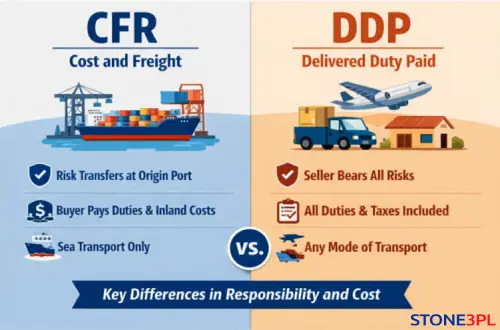
Under CFR, the seller pays ocean freight to the destination port, but the buyer assumes risk once the cargo is loaded onto the vessel. Under DDP, the seller takes almost complete responsibility for shipping, customs clearance, duties, taxes, and delivery to the buyer’s final destination.
Common Challenges With CFR and DDP
CFR Challenges
Buyers may face unexpected port charges
Import customs delays can occur
Cargo insurance gaps may create financial risk
Coordination between multiple logistics providers can be complex
DDP Challenges
Sellers face higher financial risk
Import tax calculations can be complicated
Customs compliance errors may cause delays
Shipping costs are usually higher overall
This is why businesses often rely on experienced international freight forwarding companies like Stone3pl to manage these complexities.
Why Professional Logistics Experts Care?
From a freight forwarding perspective, CFR is best for bulk commodities or non-containerized cargo where the seller has direct vessel access. However, for modern containerized shipping, CPT (Carriage Paid To) is often a more accurate alternative to CFR.
DDP is the gold standard for buyers who want a "hands-off" approach. However, it requires the seller (or their freight forwarder) to have a deep understanding of the destination country’s customs regulations to avoid costly delays.
How Stone3pl Helps Businesses Manage CFR and DDP Shipments?
As a professional international freight forwarding and 3PL service provider, Stone3pl helps importers, exporters, ecommerce sellers, and B2B businesses optimize global shipping operations under both CFR and DDP terms.
Stone3pl provides:
Global ocean freight and air freight solutions
DDP door-to-door shipping services
Customs clearance support
Warehousing and fulfillment services
Cargo consolidation
Amazon FBA logistics
Cross-border ecommerce shipping
Real-time cargo tracking
Duty and tax consultation
Supply chain optimization
Whether your business needs cost-efficient CFR shipping or hassle-free DDP delivery, Stone3pl can create customized logistics solutions that reduce shipping risks and improve delivery efficiency.
FAQ: What B2B Users Want to Know
1. Is DDP always better for the buyer?
While DDP is the most convenient, it is often more expensive because the seller adds a margin for the risk and administrative effort of handling imports. If you have a reliable 3PL partner like Stone3pl, using a term like FOB or EXW might allow you more control over your shipping costs.
2. Who pays for unloading under DDP?
Unless otherwise agreed, the buyer is responsible for the actual unloading of the goods from the arriving vehicle at the final destination. The seller's responsibility ends when the vehicle arrives and the goods are ready for unloading.
3. Why would a seller refuse DDP terms?
In some countries, import regulations require the "Importer of Record" to be a locally registered entity. If the seller does not have a local branch or a specialized customs broker, they may find it legally impossible to clear the goods, making DDP a risky choice.
4. Can I change from CFR to DDP mid-shipment?
Incoterms are part of the legal sales contract. While logistics providers can help adjust the "service" level, changing the legal responsibility mid-transit can lead to disputes regarding insurance claims and tax liabilities. It is best to define this before the Proforma Invoice is finalized.
5. Should I choose CFR or DDP for my first international shipment?
If you lack import experience or a local logistics partner, DDP is safer. If you have strong local capabilities, CFR can be more cost-efficient.
6. What are the biggest risks in CFR shipments?
The main risk is the gap between freight payment and risk ownership—buyers assume risk during transit but may not have control over shipping arrangements.
Streamline Your Global Supply Chain with Stone3pl
Navigating the complexities of CFR, DDP, and international customs can be overwhelming. At Stone3pl, we specialize in bridge-to-door solutions that take the guesswork out of international logistics. Whether you are looking for cost-effective freight forwarding under CFR or a fully managed DDP solution for your e-commerce business, our team ensures your cargo moves smoothly across borders.
Contact Stone3pl today to optimize your shipping strategy, reduce hidden costs, and experience professional 3PL service tailored to your B2B needs.


