
China–Europe Air Freight Rates: Why the Booking Window Is Narrowing Before Peak Season
The window for securing suitable China–Europe air freight rates before the 2026 holiday peak may be narrowing, particularly for sellers who need predictable space, transit schedules, and delivery dates. Reference quotes for shipments departing Shenzhen and Hong Kong indicate rates around $4.85/kg to Europe, while UK-bound services are quoted from approximately $5.15/kg. Some market forecasts suggest that rates could reach 7.20–7.80/kg by mid-November, although this remains a forecast rather than a confirmed market-wide price.
For importers, e-commerce brands, Amazon sellers, and wholesale businesses, the key decision is not simply whether air freight will become more expensive. It is whether to book earlier, move only urgent inventory by air, or use a combination of air freight, sea freight, and warehouse-based inventory staging to protect delivery commitments.
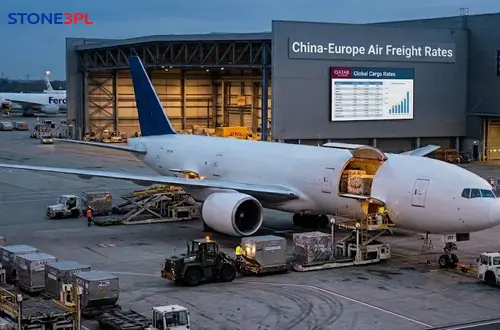
Recent industry data shows why a route-specific approach matters. In its October 14, 2026 update, Freightos reported that China–Northern Europe air freight prices fell 7% week over week, while China–North America prices rose 3%. Meanwhile, TAC Index reported that its global air freight index increased 5% in the week to October 5, with higher fuel costs and seasonal demand contributing to the broader market's firm pricing environment.
These figures do not necessarily contradict individual forwarder quotes. A specific Shenzhen or Hong Kong departure, destination airport, service type, shipment weight, and space commitment can produce a different price from a broader market index.
For businesses preparing for Black Friday, Cyber Monday, Christmas, and year-end replenishment, the practical response is to compare current bookable quotes, secure capacity where necessary, and avoid relying on a single rate forecast.
China–Europe Air Freight Rates in October 2026
The following figures provide a working reference for planning based on the market observations supplied for this article. They should be treated as indicative quotes and forecasts, not guaranteed tariffs or independently verified market-wide averages.
| Market indicator | Reference figure | How to interpret it |
|---|---|---|
| Shenzhen/Hong Kong to Europe | Around $4.85/kg | Indicative current spot quote for the stated service and route scope |
| China to the UK | From $5.15/kg | Starting quote; actual cost depends on service and shipment details |
| Forecast for mid-November | $7.20–$7.80/kg | Potential peak-season scenario, not a confirmed future rate |
| China–Northern Europe air freight, weekly index | Down 7% in the week reported October 14 | A broader benchmark showing that not all European lanes are rising together |
| China–North America air freight, weekly index | Up 3% in the same report | Evidence of different pricing momentum between major trade lanes |
Why a quoted rate is not the same as a market index
Air freight prices can differ depending on whether the quote covers airport-to-airport transportation, an air freight consolidation service, or a door-to-door solution. Other variables include:
- Departure airport and destination gateway.
- Chargeable weight and shipment dimensions.
- General cargo versus special-handling requirements.
- Direct or transshipment routing.
- Available capacity and booking lead time.
- Fuel, security, screening, handling, customs, and final-mile charges.
- Whether the quote includes customs clearance, duties, and delivery.
A $4.85/kg quote may be attractive for one shipment but not comparable with another quote if the latter includes additional services or different delivery commitments. Before booking, ask for the chargeable-weight basis, included services, surcharges, quote validity, and conditions for rate changes.
Why UK rates should be assessed separately
The UK should not automatically be priced as part of a single Europe-wide lane. UK-bound shipments may have different routing, capacity, customs, and final-mile arrangements from shipments to Germany, France, the Netherlands, or other EU destinations.
Sellers should obtain a destination-specific quotation and confirm the complete landed logistics cost. For UK shipments, confirm the relevant import clearance and tax arrangements rather than assuming that a quoted air freight rate includes every import-related charge.
Why Is the Pre-Peak-Season Booking Window Narrowing?
A narrowing booking window does not necessarily mean that every China–Europe air freight rate is rising every week. It means that shippers may have less time to secure the combination of price, capacity, routing, and delivery timing that their business needs.
Four factors deserve attention.
Factor 1: Post-holiday export volumes are returning
China's Golden Week holiday ran from October 1 to October 7 in 2026. As factories and export operations resume, cargo volumes can return unevenly across industries and departure gateways.
C.H. Robinson's October air freight update identified the period after Golden Week as an important test of Asia-origin capacity. It also noted that technology-related cargo and other high-value shipments can influence demand differently across routes.
For sellers, the implication is that the availability of a suitable flight or consolidation service should be checked directly. A rate seen before the holiday may not remain available for the same departure date, weight bracket, or service level.
Factor 2: Peak-season demand is uneven across trade lanes
Air freight is a network of individual markets, not a single global price. The China–Europe lane may behave differently from China–North America because of changes in e-commerce volumes, technology shipments, airline capacity deployment, and destination demand.
Freightos' October 14 report showed a 7% weekly decline in its China–Northern Europe air freight benchmark alongside a 3% increase in China–North America prices. TAC Index, meanwhile, reported that the global air freight market remained firm in early October, with higher fuel costs contributing to pricing pressure.
This creates an important distinction for procurement teams:
- Market index movement helps identify broader price trends.
- Forwarder quotations indicate the price available for a particular shipment and service.
- Space availability determines whether the shipment can move on the required schedule.
- Door-to-door cost reflects transportation plus applicable handling, clearance, and delivery charges.
A falling index does not guarantee that a specific urgent shipment can be booked at a lower rate. Equally, a higher quotation from one provider does not prove that every route is experiencing a market-wide increase.
Factor 3: Fuel and operating costs remain important
Airlines and freight forwarders must account for fuel, aircraft utilization, handling, security, and network disruption when pricing capacity.
TAC Index reported that jet fuel prices were more than 108% higher year over year as of October 2, 2026, according to the IATA Jet Fuel Price Monitor cited in its October analysis. Fuel is only one component of the total air freight cost, but substantial changes can affect carrier pricing and the timing of surcharge adjustments.
The relationship is not immediate or uniform. Existing contracts, fuel arrangements, route competition, and available capacity can all affect when and how costs are passed through to shippers.
Factor 4: Seasonal deadlines create a premium on predictability
For a seller preparing for Black Friday, Cyber Monday, or Christmas, the commercial cost of a late shipment can exceed the difference between two freight quotes.
A cheaper shipment that arrives after a promotional deadline may contribute to lost sales, emergency replenishment costs, and poor customer experience. A higher-priced service may be justified for a limited quantity of high-priority inventory if it materially reduces the risk of missing the sales window.
The goal is not to pay the highest available rate. It is to identify which products genuinely require faster transportation and secure the appropriate service for those products before time becomes the limiting factor.
Could China–Europe Air Freight Reach 7.20–7.80/kg in Mid-November?
The proposed 7.20–7.80/kg range is best treated as a peak-season planning scenario, not a confirmed market consensus or guaranteed November price.
Using $4.85/kg as the starting reference, a rise to $7.20/kg would represent an increase of approximately 48%. A rise to $7.80/kg would represent approximately 61%.
| Scenario | Rate per kg | Increase from $4.85/kg | Planning implication |
|---|---|---|---|
| Current reference quote | $4.85 | Baseline | Confirm the service scope and validity |
| Moderate increase scenario | $6.00 | About 24% | Review budgets and shipment priorities |
| Lower end of peak forecast | $7.20 | About 48% | Test the impact on urgent replenishment |
| Upper end of peak forecast | $7.80 | About 61% | Assess alternative modes and inventory buffers |
These percentages are arithmetic comparisons, not forecasts of what rates will actually do.
The forecast range also should not automatically be applied to the UK starting quote of $5.15/kg. UK and continental European routes can have different pricing structures, and the same percentage change should not be assumed without a route-specific quotation.
What could push rates toward the upper end?
The upper scenario becomes more plausible if several conditions occur together:
- Export cargo returns more quickly than available capacity can absorb.
- Demand concentrates on a limited number of departure dates or gateways.
- Sellers bring forward urgent shipments ahead of promotional deadlines.
- Fuel or other operating costs rise further.
- Disruptions reduce available capacity or force cargo onto alternative routings.
Conversely, the market could remain below this range if demand is weaker than expected, additional capacity becomes available, or competition among providers increases.
Recommended approach: Ask your forwarder to quote at least two or three shipment windows and compare available services, rather than budgeting solely on the upper forecast. Where possible, distinguish the price of confirmed capacity from a provisional indication.
How Much Could a Rate Increase Affect Your Shipping Budget?
A simple calculation can help businesses quantify exposure before deciding whether to ship earlier or change their inventory strategy.
Air freight cost = Chargeable weight × Rate per kg
These calculations exclude any charges not included in the quoted rate. Actual invoices may also depend on volumetric weight, minimum chargeable weight, fuel and security surcharges, origin handling, destination handling, customs clearance, duties and taxes, and final-mile delivery.
For a business shipping several tonnes each week, a modest change in the rate per kilogram can materially affect margins. But switching every shipment to a cheaper mode is not necessarily the answer: the savings must be weighed against inventory holding costs, lead time, and the commercial consequences of arriving late.
Air Freight, Sea Freight, or a Hybrid Strategy?
When air freight becomes more expensive, sellers should compare the full logistics cost and required delivery date instead of making decisions based on the freight rate alone.
| Shipping strategy | Best suited for | Main advantage | Main trade-off |
|---|---|---|---|
| Air freight | Urgent replenishment, high-value goods, time-sensitive launches | Faster transportation | Higher cost per kg |
| Sea freight | Larger shipments with flexible delivery dates | Usually more economical for bulky cargo | Longer transit and greater planning lead time |
| Rail freight, where suitable | Certain China–Europe shipments needing a middle ground between air and sea | Alternative cost-and-time balance | Availability, routing, and transit time vary |
| Hybrid air and sea | Sellers with both urgent and predictable inventory needs | Balances speed and cost | Requires better forecasting and inventory coordination |
| Third-party warehousing plus staged replenishment | Businesses needing a buffer before final delivery | More control over release timing and inventory allocation | Adds storage, handling, and onward transportation costs |
Use air freight for the inventory that needs it
Instead of moving every SKU by air, identify which products are most exposed to stockouts or missed sales deadlines. Prioritize bestsellers, products with limited remaining stock, and items tied to confirmed promotions.
Less urgent or slower-moving inventory may be suitable for a lower-cost mode, provided it can arrive in time.
Use a hybrid plan for uncertain demand
A hybrid strategy can move a smaller quantity of priority stock by air while shipping the balance by sea or another suitable mode. This can reduce reliance on a single shipment and limit the amount of inventory exposed to peak-season air rates.
The decision should be based on actual stock levels, forecast sales, production readiness, and confirmed transit schedules—not simply on the difference between two quoted rates.
Stage inventory before the final delivery step
For businesses shipping from China, warehouse staging can help separate international transportation from the final replenishment decision. Inventory can be prepared, consolidated, checked, and released according to a planned schedule, where the selected warehouse service supports these activities.
This approach does not guarantee airline space or faster customs clearance, but it can give operations teams greater control over shipment readiness and dispatch timing.
How Stone3PL Can Help Businesses Manage Peak-Season Shipping
For businesses shipping from China to Europe, transportation planning can become more complicated when rates, available space, inventory deadlines, and destination requirements change at different speeds.
Stone3PL provides international logistics services across air freight, ocean, rail, express, multimodal transportation, and warehousing. Its published service information also describes shipment booking and tracking through its online platform. These capabilities can help businesses evaluate transportation choices and coordinate logistics requirements across the shipment lifecycle.
Compare shipping options against your actual deadline
Stone3PL offers multiple transportation modes so businesses can compare options according to their budget and timeframe. Rather than assuming that every shipment needs air freight, sellers can evaluate which goods require the faster option and which may be suitable for a different mode.
Coordinate warehouse preparation and dispatch
Where the selected service supports it, warehouse operations can help prepare cargo for international transportation, consolidate shipments, and coordinate dispatch with the broader fulfillment plan.
This is useful for sellers managing multiple suppliers, product categories, or replenishment deadlines. The exact warehouse services, locations, handling fees, and service scope should be confirmed with Stone3PL before booking.
Improve visibility across shipment milestones
A shipment should be monitored from cargo readiness through transportation and final delivery. Tracking milestones help operations teams identify exceptions, communicate changes, and make informed inventory decisions.
Stone3PL's website describes global shipment tracking and logistics automation capabilities. Confirm which tracking events and notifications are available for the service selected.
Plan around total logistics cost, not the headline rate
A competitive air freight quote is only one part of a successful shipment. Businesses also need to consider dimensional weight, handling charges, customs compliance, warehousing, inventory holding costs, and the commercial cost of late delivery.
Stone3PL's article on Methods and Guidelines for Reducing International Freight Costs discusses transportation-mode selection, packaging optimization, consolidation, and warehouse strategies that can help businesses review their broader logistics costs.
Frequently Asked Questions
Is it better to book China–Europe air freight early?
Early booking can give businesses more time to compare services, confirm shipment readiness, and plan around a required delivery date. It does not automatically guarantee a lower rate or confirmed capacity. Ask the forwarder to confirm the booking status, quote validity, and conditions for any price changes.
How can sellers reduce air freight costs during peak season?
Prioritize urgent SKUs, optimize packaging, confirm chargeable weight, compare complete quotations, consolidate cargo where appropriate, and consider sea or rail for shipments with more flexible deadlines. A hybrid transportation plan can help reserve air freight for inventory where speed has the greatest commercial value.
Can a 3PL guarantee space or a fixed rate throughout peak season?
No general guarantee should be assumed. Space commitments, rate validity, and service conditions depend on the provider's agreements and the specific booking. Ask for written confirmation of the applicable terms before dispatch.
What should businesses shipping to Europe confirm before cargo departs China?
Confirm the destination, route, chargeable weight, quotation validity, shipment readiness, applicable customs documents, importer-of-record arrangements, and required VAT/EORI information. Also establish who will handle exceptions and how the shipment will be tracked through delivery.
Make the Booking Decision Before Urgency Sets the Price
The narrowing pre-peak-season booking window is a reminder that international shipping decisions need to account for price, capacity, timing, and inventory risk together.
The supplied market references—around $4.85/kg from Shenzhen/Hong Kong to Europe, UK services from $5.15/kg, and a potential mid-November scenario of 7.20–7.80/kg—are useful starting points for planning. They should be compared with current, route-specific quotations and broader industry benchmarks rather than treated as guaranteed market prices.
For importers and e-commerce sellers, the most resilient strategy is to identify urgent inventory early, compare air and alternative transportation options, prepare customs documentation in advance, and maintain a contingency plan for delayed or more expensive shipments.
Industry sources and related resources
Freightos — October 14, 2026 air freight market update


