
Is a VAT Number Required for Bulk Air Shipments to Europe?
In reality, European customs authorities enforce strict, highly automated compliance frameworks for cargo entering via air freight. For bulk air freight shipments, a valid local VAT number and EORI number are non-negotiable requirements. Attempting formal clearance without compliant tax registration leads to stuck shipments, steep airport demurrage fees, or total cargo seizure.
Table of Contents
- The Core Distinction: VAT, EORI, IOSS, and MRN
- Why Bulk Air Cargo Is Different From Small Parcels
- Do You Need a VAT Number for Amazon FBA Air Shipments?
- Compliance Comparison Matrix
- What Happens If You Ship Without the Correct Tax and Customs Setup?
- EU Air Freight vs. UK Air Freight: Don't Mix the Rules
- What About VAT Recovery?
- How Stone3PL Approaches Bulk Air Cargo
- FAQ: Air Cargo to Europe
- Industry Authorities and Resources
Commercial shipments from outside the EU generally require formal customs clearance, and the importer must have the appropriate customs and tax setup before the cargo arrives. An EORI number is mandatory for EU customs operations, while VAT registration requirements depend on the importer, destination country, transaction structure, and how import VAT is accounted for.
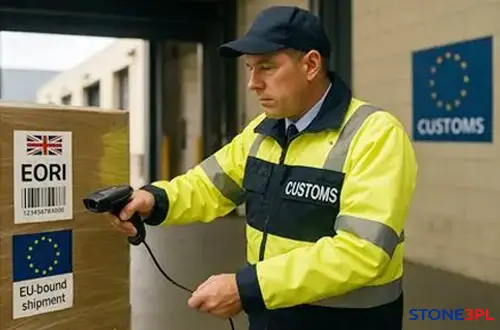
When shipping commercial air freight to Amazon FBA hubs or regional distribution centers, you are transporting high-value bulk cargo rather than low-value individual mail. This triggers formal customs entry, making both a local VAT number and an EORI number mandatory.
The Core Distinction: VAT, EORI, IOSS, and MRN
Many new sellers use these terms interchangeably. They solve different problems.
| Term | What It Is | Primary Purpose | Relevant to Bulk Air Freight? |
|---|---|---|---|
| VAT number | A tax registration number issued by a country | VAT reporting, payment, charging VAT, and potentially recovering import VAT | Often relevant, depending on structure and country |
| EORI number | Economic Operators Registration and Identification number | Identifies the economic operator in EU customs processes | Usually required for commercial EU imports |
| MRN | Movement Reference Number | Reference created for a specific customs declaration or movement | Relevant after the declaration is lodged |
| IOSS number | Import One-Stop Shop VAT identifier | Simplified VAT collection for eligible distance sales imported into the EU | Generally not suitable for bulk B2B freight or inventory replenishment |
| Importer of Record (IOR) | The legal entity responsible for the import declaration | Bears customs, duty, VAT, and compliance responsibility | Essential to define before shipping |
EORI: The Customs Identifier
The EORI number identifies the business interacting with EU customs authorities. It is not interchangeable with a VAT number. EU guidance states that businesses importing, exporting, or moving goods into the EU need an EORI number for customs purposes.
In practical terms, if your company is the importer for a commercial air shipment from China to an EU airport, your customs broker will normally need the appropriate EORI information to lodge the declaration.
VAT: The Tax-Compliance Identifier
A VAT number relates to tax registration, VAT reporting, payment, and—in eligible cases—recovery or deduction of import VAT.
Whether you need VAT registration in the import country depends on factors such as:
- Whether your business owns the goods when they enter the EU.
- Who acts as importer of record.
- Which EU country is the import location.
- Whether inventory will be stored locally.
- Whether the goods will move to another EU member state after import.
- Whether you make taxable local sales.
- Whether you use a deferred-import-VAT or other national mechanism.
- Whether an EU entity, fiscal representative, or service provider is involved.
MRN: Proof That a Customs Declaration Exists
The Movement Reference Number is generated for a specific customs declaration or movement. It is not a replacement for EORI or VAT registration. Think of it as the reference number for a shipment’s customs event—not as your standing customs or tax identity.
IOSS: Designed for Low-Value Consumer Parcels, Not Bulk Replenishment
IOSS is designed for certain distance sales of imported goods in consignments with an intrinsic value of no more than €150. It does not provide a general customs-and-VAT solution for palletized air cargo, inventory replenishment, Amazon FBA stock, or bulk shipments sent to an EU warehouse.
In addition, from 1 July 2026, the EU introduced a temporary €3 customs duty per item for low-value consignments of up to €150 imported from outside the EU. The measure applies to distance sales and does not make bulk freight eligible for IOSS simplification.
Why Bulk Air Cargo Is Different From Small Parcels
A major misconception among new cross-border sellers is:
“If a courier can deliver a small parcel without me personally handling customs, my bulk shipment should work the same way.”
Bulk cargo sent by air to an EU warehouse is generally part of a commercial import process. An EU customs declaration is a formal legal act placing imported goods under a customs procedure. The European Commission notes that declarations are normally made by the owner of the goods or a representative acting on the owner's behalf.
The logistics process therefore needs to answer several questions before departure:
- Who owns the goods?
- Who is the importer?
- Who will make the customs declaration?
- Which EORI will be used?
- Who is responsible for import VAT and duties?
- Where will the goods enter free circulation?
- Are the goods moving directly to an EU warehouse or under another customs procedure?
- Does the importer have the required VAT registration or tax treatment for the transaction?
This is why customs planning should happen before booking the flight—not after the cargo reaches the airport.
Do You Need a VAT Number for Amazon FBA Air Shipments?
This is one of the most common questions from e-commerce sellers.
The answer is:
You need to determine the VAT and customs obligations associated with the importer and the specific FBA replenishment structure. A VAT number should not be treated as a universal substitute for the EORI or customs declaration requirements.
For example, a seller sending commercial inventory from China to an Amazon fulfillment center in Germany needs to establish:
- Who is the importer of record?
- Which entity is making the customs declaration?
- Which EORI is being used?
- How will import VAT be handled?
- Is the seller required to be VAT registered in Germany or another relevant jurisdiction?
- Is the shipment being imported directly into free circulation?
- Is a customs representative involved?
Simply putting an Amazon warehouse address on the commercial invoice does not answer these questions.
Amazon's warehouse is a destination. It does not automatically determine who bears the legal responsibility for import clearance.
Compliance Comparison Matrix
| Shipping Model | IOR Ownership | Customs Risk Level | Tax Audit Exposure | Account Safety |
|---|---|---|---|---|
| Direct Own-VAT Air Freight | Importer's Own VAT/EORI | Minimal | Fully compliant; reclaimable Import VAT | 100% Secure |
| 3PL Bonded Clearance (Deferred) | Importer's VAT via Postponed VAT Accounting (PVA) | Low | Cash-flow optimized; fully legal | 100% Secure |
| Tax-Inclusive "All-In" Channel | Shared Third-Party VAT | Extremely High | Severe risk of cargo seizure & tax fines | High Risk of Account Suspension |
Without a compliant VAT number on file, your cargo will not be released after landing. Instead, it will be held at the airport bonded warehouse, where daily storage fees can quickly accumulate to €80–€150 per pallet. In the worst documented cases we have seen, sellers waited 3+ weeks to resolve VAT documentation issues, only to face customs-ordered cargo destruction and permanent VAT number audits.
Import VAT paid during this formal clearance process is not a sunk cost. Once you hold a valid local VAT registration, you can reclaim or offset that import VAT through periodic tax filings — a core part of legitimate European cross-border e-commerce compliance that many new sellers never fully leverage.
What Happens If You Ship Without the Correct Tax and Customs Setup?
The most common mistake is waiting until the cargo arrives before discovering that the documentation is incomplete.
Potential consequences include:
1. Customs Clearance Delays
If the importer information, EORI, commodity code, valuation, or supporting documentation is incorrect, the shipment may be held while the declaration is corrected.
2. Airport Storage Charges
Air cargo occupies valuable handling and storage capacity. Delays can create additional warehouse, handling, inspection, or storage charges.
3. Unexpected Duty and VAT Payments
Import VAT and customs duty are calculated according to the applicable customs and tax rules.
The European Commission notes that the taxable amount for import VAT generally starts with the customs value and can include applicable duties, taxes and certain incidental expenses.
4. Documentation Rework
A customs broker or logistics provider may need to obtain revised invoices, packing lists, product descriptions or importer information.
5. Inventory Disruption
For Amazon FBA sellers, a customs delay can eventually become an inventory problem.
A delayed replenishment shipment may contribute to:
- Low FBA inventory
- Longer customer delivery times
- Lost sales
- Increased emergency shipping costs
- Additional operational pressure
This is why customs readiness is ultimately an inventory-management issue, not simply a documentation issue.
EU Air Freight vs. UK Air Freight: Don't Mix the Rules
Another frequent source of confusion is treating the UK as part of the EU customs territory.
Following Brexit, Great Britain operates under its own customs system.
For imports into England, Scotland and Wales, businesses generally need a GB EORI to make imports. GOV.UK explicitly states that businesses need a GB-prefixed EORI for imports into Great Britain.
Import VAT and customs duty are also handled under UK rules.
HMRC states that businesses importing goods into Great Britain need to follow the applicable import declaration process, and VAT-registered businesses may be able to recover import VAT subject to the relevant requirements.
Therefore:
EU shipment ≠ UK shipment
Do not assume that an EU VAT/EORI setup automatically covers an import into Great Britain.
What About VAT Recovery?
Import VAT should not simply be viewed as an unavoidable logistics expense.
Depending on the business structure and local VAT rules, a VAT-registered business may be able to recover import VAT through its VAT return or other applicable mechanism.
For example, HMRC explains that eligible UK VAT-registered importers can use import VAT documentation to recover VAT as input tax.
The precise treatment varies by jurisdiction.
Therefore, sellers should work with their tax adviser or VAT specialist to determine:
- Whether VAT registration is required
- Where registration is required
- Who should act as importer
- Whether import VAT can be recovered
- Whether postponed accounting is available
- What records need to be retained
A 3PL can coordinate logistics and customs documentation, but tax advice should come from an appropriately qualified tax professional.
How Stone3PL Approaches Bulk Air Cargo
Stone3PL combines international freight forwarding, warehousing and fulfillment instead of treating transportation as an isolated service.
Its published logistics infrastructure covers air, ocean, rail, express and multimodal transportation, alongside global warehouse capabilities.
For B2B sellers shipping inventory from China to Europe, this integrated model can connect:
China supplier → China warehouse → Consolidation → Air freight → Customs clearance → European warehouse → Order fulfillment
Stone3PL also provides a shipping-rate calculator that allows users to compare routes and destinations, including European warehouse locations such as Frankfurt.
This is particularly useful for sellers who need to compare speed versus landed cost, rather than automatically choosing air freight for every replenishment.
Stone3PL also publishes practical guidance on international freight costs, including the effect of dimensional weight, consolidation, transportation-mode selection, peak-season surcharges and overseas warehousing.
FAQ: Air Cargo to Europe
How long does compliant air freight customs clearance take in Europe?
When documentation (AWB, commercial invoice, packing list, and valid VAT/EORI details) is pre-filed prior to flight arrival, standard air freight clears customs within 12 to 24 hours of landing at major airports like Frankfurt, Amsterdam Schiphol, or Paris CDG.
Is an EORI number the same as a VAT number?
No. An EORI is primarily a customs identifier, while a VAT number is a tax identifier.
They may be related in some countries, but they serve different regulatory purposes.
What documents are needed for bulk air freight customs clearance?
Typical documents include a commercial invoice, packing list, air waybill, EORI information, VAT details where applicable, correct HS codes, accurate goods descriptions, country-of-origin data, importer-of-record authorization, and product-compliance records where required. The customs broker may request additional documents based on the product and route.


